

Running a multi-brand company means managing an endless sea of brands, collections, colors, finishes, and custom configurations. For years, capturing all these possibilities required weeks of planning, costly visualizations, and budget-draining photoshoots. It was a slow process, but an absolutely necessary one. Why? Because as human beings, we are deeply visual creatures.
Picture this: 10 brands, 20 pieces of furniture each, and every single piece available in up to 50 different finish combinations. It is impossible for a manufacturer to produce and photograph all of that, let alone for a dealer like us at Studio Pollina. Samples, 3D models, revisions, and then even more samples and models. In the past, fulfilling a request like that was a heavy logistical journey.
No matter how vividly we try to describe a piece of furniture or show a tiny fabric swatch, our clients' emotions only truly ignite when they see a realistic image in front of them. That visual spark is what turns "I’m not sure" into "I want that in my space." When a client can actually see the final result, their imagination kicks in, all doubts fade away, and the decision-making process becomes incredibly easy.
We knew there had to be a smarter way to deliver that feeling. With Sopla.app, we shorten the distance. Their product is a key tool for the future of brands and a game-changing opportunity for manufacturers to scale their visual content efficiently.We can now visualize the furniture not only in different finishes but also in real-life scenarios and various types of spaces. This capability expands our horizons and provides much greater assurance for both us and our clients.
To celebrate this collaboration, we sat down with Maciej Mazur, the creator of Sopla to talk about their vision, the struggles of the furniture industry, and how their tool is changing the game sustainably, not by trying to replace the traditional work of a creative director, but by serving as a powerful tool in their hands.
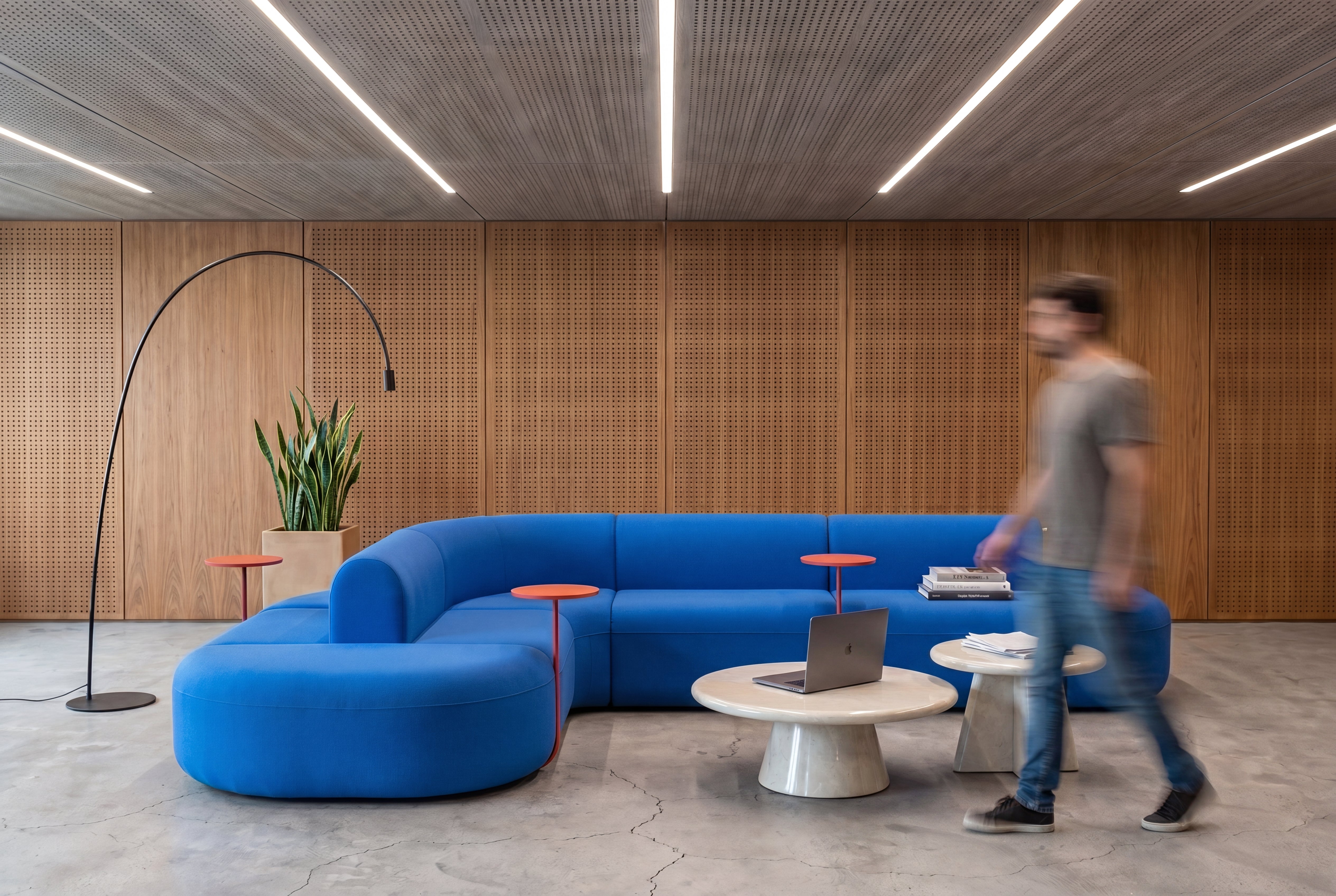
 Artiko Seating Sytem by MDD
Where did the name Sopla come from, and does it have a symbolic meaning in the context of what the app creates?
"Sopla" means "blow!" in Spanish. It’s what people say when someone blows out birthday candles and makes a wish. But it is also a reference to a gust of wind that causes movement. Because that is exactly what we do: Sopla.app turns static furniture packshots into dynamic video materials in one simple action, almost like a puff of air.
What problem did you notice on the market that became the impulse to create Sopla.app?
The idea for the app came to me when I read in Forbes that 78% of people prefer to discover new products by watching short videos. In the world of shorts, stories, and TikToks, moving images have become the most engaging format. However, it has a fundamental flaw: it lives a very short life. Sometimes 24 hours, and sometimes only a few seconds, because a video about a piece of furniture has to compete for attention with a funny video of a dog (and I completely understand that the dog wins!).
In the furniture and interior design industry, content production is very expensive and hard to scale. From conversations with Sopla users, we know that they need hundreds of photos and an increasing number of videos for online stores, marketplaces, and social media. AI technology allows us to shorten this process from weeks to minutes and has become a simple way to regularly create new content.
 Nimm Chair by Paged
How did your personal career paths lead to the creation of this product?
Content production has always been close to me professionally, as I have been running a graphic design studio for 20 years, which has prepared hundreds of advertising campaigns for leaders in their industries, including Panattoni, Sony Music, and Edyta Górniak.
Łukasz, the co-founder of Sopla, has over 15 years of experience in quality management and operations. We decided that this is an exceptionally good combination of competencies. We understand that content not only has to look good, but that the product itself also has to work: it must be fast, simple, and effective.
Both of us love design and well-designed objects. We also have friends in the industry who sparked our appreciation for furniture, so this choice was very natural for us.
What distinguishes Sopla.app from other AI tools for creating photos and videos?
AI is not a magic wand. If you want to get a piece of furniture in a good interior, you have to describe it precisely, meaning you have to create a prompt. You need to know how to do it and how to "talk" to specific AI models. You can learn this (and in my opinion, it's worth it!), but it takes time, and having the knowledge still doesn't free you from the tedious task of describing details. In Sopla, we designed the interiors for the user. We manually created several thousand records and are constantly creating new ones.
What sets us apart is that creative decisions are made by humans rather than left to the machine. In Sopla, AI acts primarily as an execution engine. It is like an advanced graphic program that creates a montage of our ideas.
 Litt Armchair by Balma
Who did you create Sopla.app for, and what are the three biggest problems it helps solve today?
Our users are primarily furniture manufacturers, large wholesalers, and online stores. But we also cooperate with creative agencies that serve furniture makers, and with interior designers who need to visualize furniture in specific rooms.
Let me give you three real examples of problems we’ve solved:
-
Faster Catalog Creation: The Danish brand Furnhouse completed their 2026 furniture catalog in a few weeks instead of months. When we received the printed 150-page copy, we knew our product worked.
-
Cost-Effective Styling Variations: The Polish oak furniture manufacturer KEDA considered Sopla a "gamechanger" in the furniture industry. When designing a new website, they presented the same products in completely different interior styles: industrial, old-town, and modern premium. Some of their tables are 4 meters long, so staging photoshoots in several different interiors would be very expensive.
-
Visualizing Non-Existent Variations: The Polish brand Flamingos regularly presents its furniture in new finishes and fabrics. They design fantastic textiles, and the material swap option means they can show customers products that don’t physically exist yet.
 Fox Armchair by 366 Concept
Will AI replace traditional content creation tools, or rather become their natural extension?
It depends on what we mean by traditional tools. If you are asking about traditional graphic and video editing software, I think that in a few years, artificial intelligence might replace them entirely because it will become the executor of commands given by a human or AI agents. Will it replace traditional photoshoots and video productions? I hope not.
I think brands will continue to create materials in the traditional way, e.g., an annual advertising campaign, but because no one will want to watch it for 365 days a year, they will rely on tools like Sopla to support those efforts. There is no reason why photoshoots and fast content produced with the help of AI couldn't coexist. Naturally, almost everyone will use AI as a technological extension in the post-production of traditional shoots, because it is already a tool just like Photoshop, for example.
Where do you think humans are still indispensable, even with the most advanced AI solutions?
AI is excellent at handling repetitive tasks, but humans will still be needed to define aesthetics and make creative decisions. A human will remain indispensable wherever context, intuition, and a deep understanding of the brand are required.
AI can generate dozens of great photo variants, but it doesn't know which one will be most consistent with the company's character and aspirations. Working with AI today is like a traditional photoshoot where dozens of pictures are taken. But ultimately, it’s the human who decides which ones are actually used.
If a brand doesn't have access to its own designers or creative directors, it should consciously choose tools that are not merely simple generators, but behind which stand people, their ideas, and previously made decisions.
 Fox Armchair by 366 Concept
What is your favorite Sopla.app feature and why?
Adding people to the created photos. As a graphic designer, I perfectly understand the need to show a product aesthetically: a minimalist background, delicate contact shadows, a chair casually balanced on one leg. Great! I know that such things make an impression... but mainly on designers ;)
Customers are much more likely to buy that chair when they can picture themselves in the scene. A family at breakfast, morning light shining into the dining room, and an everyday moment they would like to experience themselves. That’s when one of the most basic consumer emotions kicks in: "I want that too!".


