

Are You an Extroverted Introvert Too? Neurodiversity and Spaces That Give Us a Choice
You may love people, lively restaurants and long conversations, only to crave complete silence the following day. You may thrive in meetings yet need solitude to truly concentrate. You may enjoy intense colours but begin to feel overwhelmed by them after a few hours.
Is that a contradiction? Not necessarily. Our nervous system does not operate in exactly the same way at all times. It responds to fatigue, stress, the presence of other people, light, sound, scent and the number of stimuli surrounding us. A well-organised space should therefore not impose one way of functioning. It should offer a choice.

What does neurodiversity actually mean?
Neurodiversity describes the natural variation in how human brains receive sensory stimuli, process information, learn, communicate, and regulate attention and emotions. There is no single “correct” way for a brain to function.
The concept refers to the population as a whole - a group of people can be neurodiverse in much the same way as it can be culturally diverse. When referring to an individual, we speak instead of someone being neurotypical or neurodivergent. Forms of neurodivergence include autism, ADHD, dyslexia, dyspraxia and Tourette syndrome, among others.
The concept of neurodiversity was not created by one person. It developed collectively, particularly through self-advocacy movements and autistic communities. It introduced a different perspective: instead of assessing every way of functioning against a single model of normality, it allows us to recognise individual challenges alongside abilities and needs.[1]
This does not mean that everyone is neurodivergent. We do, however, all experience space through our own nervous system, and we do not always need the same things from it.

Noti, Cactus Shelf
The extroverted introvert: personality is not static
“Extroverted introvert” may sound like something taken from an online personality quiz, yet it captures an idea that personality psychology has explored for decades: our behaviour changes depending on the situation.
Psychologist William Fleeson proposed understanding personality traits not only as fixed labels but also as distributions of different states expressed over time. The same person may behave in a highly extroverted way in one environment and need withdrawal and limited interaction in another.[2]
Introversion and extroversion are not forms of neurodivergence. They do, however, show why placing the users of a space into rigid categories is rarely enough. We are not the same version of ourselves every day or at every hour.

VANK, ELIPSE Acoustic Pannels
One interior, many nervous systems
We do not experience space through vision alone. We hear it, touch it and sense its temperature and scent. Light changes the way we perceive colour, the texture of a material affects our sense of comfort, and the sound of footsteps or a chair moving across the floor can determine whether we continue to feel at ease or begin to experience sensory overload.
This is where we can speak of the synesthetic qualities of space - the conscious creation of relationships between the senses. This should not be confused with synesthesia as a specific neurological phenomenon in which stimulation of one sense automatically triggers an experience in another. Here, it describes an approach to interiors in which light, colour, touch, acoustics and scent form one experience.
In the context of neurodiversity, there is therefore no single set of colours, materials or furniture that will work for everyone. What matters far more is the possibility of choosing between openness and enclosure, movement and stillness, social contact and temporary withdrawal.
 MDD, Linka Sofa
The home: not everyone rests in the same way
Differences become particularly visible in a private home. One person may regenerate through conversation and music, while another needs silence at exactly the same moment. Someone may enjoy working at a shared table, while someone else can only gather their thoughts in a more sheltered setting.
The more people share a home, the less effective it becomes to treat every room as a space with one fixed function. We need places for connection, but also opportunities to withdraw without becoming completely disconnected from domestic life.
Alcoves, high-backed seating, lightweight movable armchairs, curtains, rugs and furniture that creates a smaller zone within a larger room can all help. Sometimes simply turning a chair in another direction is enough. At other times, we need a form that provides a greater sense of visual and acoustic enclosure.
 TAMO, Vazoo Bookcase
Materials matter too. A pronounced upholstery texture may provide pleasant, grounding tactile input for one person while feeling overly intense to another. Instead of searching for a universally ideal material, it is therefore worth combining different textures and allowing users to choose.
The floor is also part of the sensory landscape. Wood, laminate and vinyl flooring can transmit footsteps differently and alter the sound of a room. The distinction does not depend exclusively on whether a material is natural or synthetic. Surface hardness, installation method, underlay and the presence of rugs, curtains and upholstered furniture also play a role. Two interiors that look very similar can therefore sound entirely different.

366 Concept, Bar Stools M75 in Velvet Sierra W03 Photo Credits: Bar du Champagne
The restaurant: everyone comes to eat, but not for the same experience
Restaurant guests may appear to share one objective. In reality, they enter the space in different states and with different intentions. One person wants to wind down after an intense day. Someone else is celebrating. Another guest is meeting a business partner and needs a relaxed yet discreet conversation. A family with children will use the same interior differently from a couple looking for intimacy.
A uniform dining room with identical lighting, tables and sound levels does not respond to this diversity. A mixture of different settings provides considerably more choice: tables near a window and more sheltered seating, communal and smaller tables, livelier areas and quieter zones.
Acoustics are as important here as the menu. Smooth, hard surfaces reflect sound, while upholstery, curtains, acoustic panels and other porous materials can reduce reverberation. As noise levels rise, conversation requires more effort, and a person who is sensitive to sound may become tired considerably faster.
Sound also influences our experience of food. Research by experimental psychologist Charles Spence shows that auditory stimuli can alter our perception of qualities such as crispness, freshness and flavour intensity.[3]
This is synesthetic thinking in practice: a chair that looks beautiful but creates a loud scraping noise when moved is not only a visual object. It is also a sound, a movement and a bodily reaction. A soft seat may provide more than physical comfort - it can also change the acoustic environment and the sense of intimacy around a table.

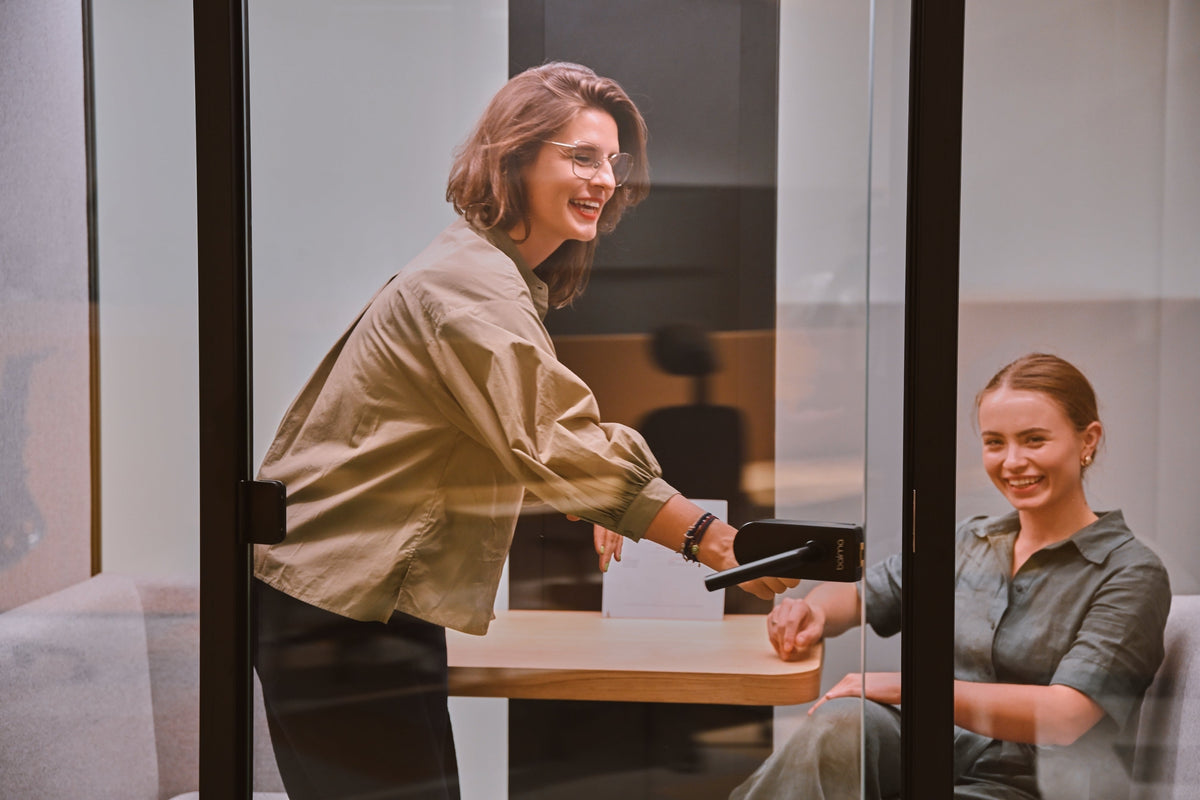
BALMA, B-Box Acoustic Booth
The office: where the widest range of needs comes together
Work requiring intense concentration, telephone calls, team meetings, presentations, informal conversations over coffee and breaks may all take place in the office at almost the same time. The people entering this shared environment have different temperaments, working styles and levels of sensory sensitivity.
Research into open-plan offices shows that easier communication does not always compensate for the loss of privacy and acoustic comfort. In a study by Jungsoo Kim and Richard de Dear, people working in fully open-plan offices evaluated many aspects of their environment less favourably than those using workplaces with a greater degree of privacy.[4]
The answer does not necessarily lie in returning to corridors lined with closed individual offices. What is needed instead is an ecosystem of settings: individual workstations, small conversation spaces, project tables, phone booths, a canteen, areas for regeneration and places where people can remain close to others without being required to interact.
The ability to regulate one’s environment is essential: changing position, selecting a place, reducing visual stimuli, moving to a quieter zone or adjusting the lighting. A systematic review of research into workplaces for neurodivergent people highlights the value of solutions that reduce sensory overload and allow the environment to be adapted more closely to the individual user.[5]
Carefully selected furniture can help create these conditions. Soft partitions and high-backed seating provide a sense of enclosure while supporting acoustic comfort. Mobile furniture makes it possible to change a layout without rebuilding the entire office. Different types of seating allow users to choose their position and their preferred degree of contact with the surrounding environment.
Design that takes neurodiversity into account does not say, “This solution works for everyone.” It says, “Within this space, you can find a solution that works for you - even when your needs change throughout the day.”

BALMA, B-Box Acoustic Booth
Well-selected furniture can do more than simply look good
Studio Pollina is not an interior design studio. We are a curator and furniture-selection partner for architects, companies and private clients. We therefore consider furniture not only in terms of its form, but also in terms of the ways in which it allows a space to be used.
We look for products that can support different sensory needs and different scenarios of everyday life. A sofa can organise an open social area, while a high-backed model can create a more sheltered island. A mobile armchair allows the user to determine their distance from others. An upholstered bench can define a boundary, provide a place to rest and influence the acoustic qualities of an interior at the same time.

366 Concept, Fox Lounge Armchair
Our selection process considers the synesthetic qualities of a product: how the material appears in changing light, how it feels to the touch, how it interacts with the floor, whether it absorbs some of the surrounding sound and what sensations its texture evokes.
We do not assume that one fabric, form or colour palette will be suitable for everyone. We see the value of a collection precisely in its diversity: in products that are soft and enveloping, visually neutral or expressive, mobile or stable, open or protective.
Our role is to select furniture that gives architects and clients the tools to create more flexible spaces. We do not prescribe one correct way to use an interior. We help select products that enable many scenarios, including those in which the needs of the same person change over time.

MUTE, Acoustic Solutions
A space does not need to know who you are
It does not need to recognise whether you are an introvert, an extrovert, neurotypical or neurodivergent. Nor does it need to assume that tomorrow you will need exactly the same things as you do today.
It is enough for a space to offer the possibility of moving closer or withdrawing, of conversation or silence, of intensity or calm. It should allow you to find your own place without having to explain your needs.
Perhaps this is the most human form of design and furniture selection: not creating one supposedly perfect space for everyone, but creating conditions in which different people can discover their own way of being.


