

Two Polish brands, two ways into the circle. LOOPE and VANK on material, people and what it really means to design responsibly.

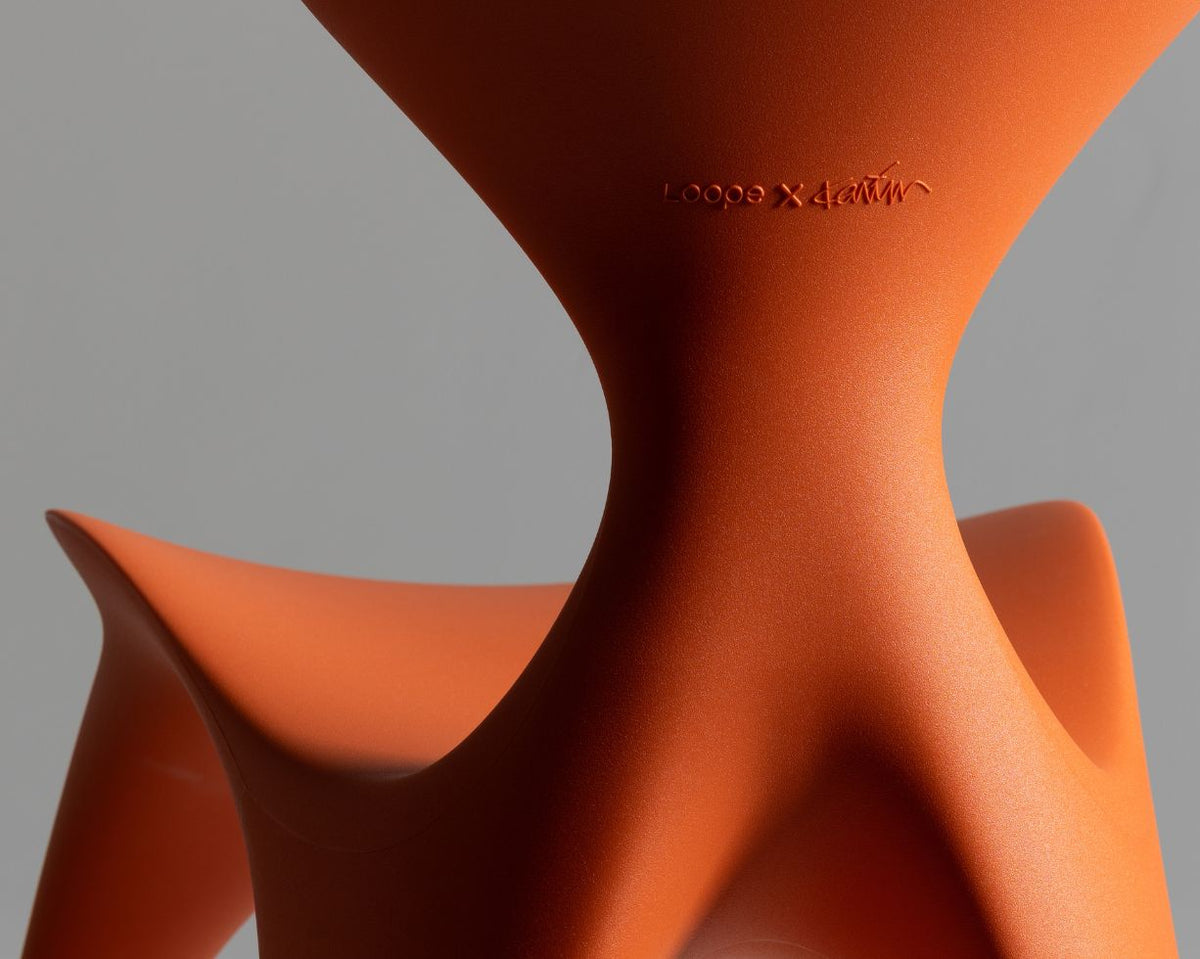
LOOPE, Armstrong Collection
Beyond the Single Life of an Object
For most of the last century, furniture followed a straight line. Raw material was extracted, shaped, sold, used and eventually thrown away. The economy rewarded speed, novelty and replacement.
Circularity asks a different question. What if a product's end of life were simply the beginning of its next one?
In a circular model, materials stay in use for as long as possible. Products are designed to last, to be repaired, taken apart and, at the very end, recovered. A closed loop goes one step further: the same material is collected, reprocessed and formed into something new.
But there is no single road to circularity. To show how differently it can be approached, we asked two Polish brands the same set of questions.
LOOPE works with a single material, pure UV-stabilised polyethylene, shaped through rotomoulding in its own factory. Post-production waste goes straight back into production, every piece is 100% recyclable, and the brand's line beneath its logo says it all: Endless Circular Craft.
VANK takes a different path. Known for its modular furniture and acoustic solutions for workspaces, the brand experiments with many materials at once: flax and hemp fibres, recycled materials and post-industrial foam, all designed to be taken apart, reconfigured and given a second life.

VANK, Flip Acoustic Walls
![]() Meet Both Brands at ORGATEC 2026
This month, both brands bring their ideas to Cologne for ORGATEC 2026. If you are visiting, you can see the conversation below come to life.
LOOPE celebrates the official debut of OUTi, its newest collection of modular furniture, created in the spirit of Endless Circular Craft. The stand, designed in earthy tones together with Naboo Studio, is at:
- Location: Koelnmesse, Cologne
- Hall and stand: Hall 10.2, Stand N002
- Dates: 27 to 30 October 2026
VANK hosts an off-site exhibition alongside the fair, titled Circular Can Be Funky, the same idea the brand speaks about later in this interview. Expect recycled materials, plant fibres, renewed products and modular lounge seating such as the VANK modular sofa.
- Location: Smartvillage, Cologne
- Dates: 27 to 29 October 2026
Two Brands, Same Questions
One brand closes the loop around a single material. The other opens circularity up to many. Here is what they told us.
Who Has the Final Say?
Every design process has a hierarchy. So we began with the most direct question: when a design decision is made, who or what decides? The user, the material, aesthetics, technology or the numbers?

For LOOPE, the answer is clear.
"At LOOPE, the material plays a key role. Polyethylene and the rotomoulding technology we use offer almost unlimited possibilities for creating shapes that cannot be achieved with any other technology. That is why organic, fluid, unusual forms are possible for us, and they are exactly what we look for in our creative process."
The material matters for a second reason, too: it never leaves the system.
"We reuse post-production waste. This is how furniture is made from materials recycled in our own factory. All of our furniture is 100% recyclable, which means that after years of use it can come back to us, and we can create new forms from the same material."

VANK answers the same question with a deliberate balance.
"There is no single answer. At VANK, design is always an attempt to find a balance between these elements. Very often the impulse comes from the material or the technology, because that is where we see the possibility of doing something differently. But material alone is not enough. It has to translate into a functional product, a good space and a good user experience."
The two starting points meet in an unexpected place. Both brands see material not as something chosen at the end, but as the beginning of an idea. LOOPE puts it in a single sentence:
"Truly bold design begins with a question: what can we do with what we already have?"

VANK describes how that question plays out in practice, starting with one of the most common and most problematic materials in the industry.
"Polyurethane foam is a very common material in furniture making, but problematic when it comes to what happens to it afterwards. So we started looking for ways to use post-industrial foam, and at the same time to design products that can be taken apart. Sometimes we start with the user, and sometimes with the material. The most interesting projects are created when these two points meet with technology."

And is circularity a starting point, a natural result, or a business commitment? Here the two brands are surprisingly close.
"Definitely a starting point, but it also comes naturally to us. We have our own factory and our own resources, and the closed loop is part of our everyday work. We do not treat it as a business commitment, because it is the foundation of LOOPE's philosophy, and that will not change." (LOOPE)
"Today, more and more often, it is the starting point. Our transformation began with the decision to analyse materials and look for better solutions with every new product. Over time, this principle stopped being a separate project and became part of the way we design. I would not say that circularity is a rigid set of rules for us. We are more interested in thinking in these terms: where the material comes from, how the product is made, how long it can be used, whether it can be repaired, taken apart, changed or given a new purpose." (VANK)

VANK, Elipse Wall Panels
Designing for the Person, Not Only the Planet
A material-led process could easily forget the person at the end of it. Both brands insist it does not. But they picture that person in different ways.
For LOOPE, it starts with the body.
"This person should feel pleasure in being with our furniture. It is not their body that should adapt to the furniture. The furniture should fit their body perfectly and seamlessly. Organic shapes, such as the ANIMA chair, express this fully. An architect should be able to adapt the furniture to an existing space. The modularity of the OUTi collection illustrates this perfectly."

Loope, ANIMA Collection
For VANK, it starts with the way we live and work today.
"It is a person who no longer wants to function within a rigid division between work, rest and meetings. Especially in office spaces, we see that people need choice: sometimes they want to concentrate, sometimes to talk, and sometimes simply to sit more comfortably. We want the user to feel at ease, comfortable and a little intrigued. We do not want to create anonymous objects that simply fill a space. A VANK product should have character and make people want to touch it, sit on it, move it, change its configuration. That is why colour, texture and the naturalness of materials are so important to us. A space should be functional, but not impersonal."
VANK takes this one step further, with a question that sits very close to our own work in healing design and spatial well-being: can a space be truly sustainable if it meets environmental targets but does not support the people in it?
"Space is created for people, so its impact on people should be just as important as its environmental impact. Good acoustics, the ability to focus, privacy, comfort, ergonomics, access to different ways of working and the possibility to change the layout: these are not extras. That is why at VANK we are interested in combining ecology with ergonomics, acoustics, mobility and wellbeing. A sustainable product should not only be 'better for the environment'. It should also serve people well."

VANK, ELLIPSE Acoustic Pod
LOOPE adds a dimension we rarely hear in the furniture world: attachment. What happens to our relationship with an object when it does not disappear, but returns in a new form?
"At some point, most of us will part with a piece of furniture that no longer fits our lives. Sometimes a part of our heart goes with it. When we let go of a piece, we also lose the memories attached to it. But what if you could buy a chair that one day transforms into a table, adapting to your new needs? A chair we are attached to can become a side table. It will still be the same material. The soul of the piece remains, just in a different shape."
Two answers, one shared conviction: responsible design is not only about materials. It is about how people feel in a space, and how long they want to keep what they live with.

Responsibility Does Not End at the Checkout
Where does a manufacturer's responsibility end? On this question, LOOPE and VANK give the same answer: not at the moment of sale. What differs is how they make it real.
LOOPE relies on the endless life of one material.
"Our responsibility does not end at the moment of sale, because we are ready to take a piece back after years and reprocess it into something completely new. Polyethylene can be reprocessed many times, so the life cycle can be endless. That is exactly why the guiding line beneath the LOOPE logo reads Endless Circular Craft. Our polyethylene furniture comes with a 10-year warranty. But even after those ten years, it does not reach the end of its life, thanks to the durability of the material."

VANK builds responsibility into the structure of each product.
"If we design a product responsibly, we should also think about what will happen to it in a few, a dozen or several dozen years. That is why disassembly, the ability to separate components, replacing parts, modularity and the use of materials that can be given a new purpose are so important to us. A manufacturer's responsibility begins before production, but it should not end at the sale. It should cover the entire life cycle of the product, and ideally also what happens to the materials after it is no longer in use."
For architects and developers, these are two complementary answers to the same brief: a material that can be reformed endlessly, and products that can be taken apart, repaired and reconfigured.
The Courage to Experiment
The market often rewards what is safe and familiar. So how do you stay bold when buyers expect proven, easy-to-sell products?
For VANK, experimentation is part of the brand's DNA.
"From the very beginning, we were interested in technology and in using it in new ways. In the early years, this meant aluminium castings and the technical character of our products. Later, we began experimenting with plant-based materials, recycled materials and post-industrial solutions. Of course, a product has to be technically proven and respond to a real market need. But we do not want the market to be the only source of design decisions. Sometimes you first have to show users a possibility they do not yet know. That is how it was with flax and hemp materials. Their natural texture and slight colour variations are not a flaw. They simply require a change of habits and a new way of looking at material."
That decision is the one VANK is most proud of.
"We decided to take materials of biological origin truly seriously and not reduce them to a curiosity. When we started working with flax and hemp fibres, it was not obvious that such a material could become the basis for an entire family of products. Today we see that this very naturalness of the material is one of the things that attracts people. Technology and nature do not compete with each other. Together, they create something new."

VANK, Flip Wall Panels
LOOPE's boldest step came this year, with a designer few expected.
"When we invited Karim Rashid to collaborate, we knew we were approaching a designer whose aesthetic differs from the designers we had worked with so far, but who understands very well what responsible design means. The reaction of the international audience in Milan during this year's Salone del Mobile confirmed that aesthetic courage and environmental responsibility are today the only right way forward. This is how the ANIMA dining series, the sculptural SWAY lounger and the architectural RISE planter came to life."

LOOPE, RISE planters
Asked which project best expresses their mission today, both brands point to something that goes beyond a single object. LOOPE returns to its roots: the founding collections with Studio Rygalik, ROUNDER, ARMSTRONG, OneL, ALLin and faT Table, which shaped the values the brand still follows. VANK points to a system.
"Today I would choose VANK_CUBE. It combines many elements that are important to us: a new material, technology, modularity, the possibility of creating your own configurations and a strong, recognisable form. CUBE also shows that a biomaterial can become the source of a completely new design language. The user gets not one piece of furniture, but a system they can change and rebuild. Responsibility not as a limitation, but as an opportunity to create something new."

VANK's Statement: "Circular Can Be Funky"
For years, sustainable design was associated with restraint: neutral colours, modest forms, a sense of sacrifice. Both brands want to change that, each in its own way.
"We want to show the opposite: that recycled, plant-based or post-industrial material can become the basis for a product that is bold, colourful and attractive. Hence our exhibition series Circular Can Be Funky. For us, it is not just a slogan, but an attempt to show a different way of thinking: circularity can be a source of creativity, not a list of prohibitions." (VANK)
"We are calling for responsibility. Design must move beyond throwaway culture. It should evolve, not fade away. Material that is recycled and reformed becomes a carrier of value that lasts longer than passing trends." (LOOPE)

LOOPE, ARMSTRONG Sofa
Ten Years From Now
Will they still be furniture makers in a decade? Here the two paths diverge most clearly.
LOOPE stays true to furniture, with a clear direction:
"We hope to always be a furniture manufacturer. But we are clearly moving towards modular furniture, ideal for all kinds of public spaces: offices, residential developments, hotels, shopping centres, restaurants, waiting areas, urban spaces, terraces, gardens and outdoor leisure areas."
VANK sees the boundaries blurring:
"I think the line between these categories will become increasingly blurred. We do not want to be only a manufacturer of more furniture. We are interested in developing materials, technologies, modular systems and solutions that allow space to be organised differently. Perhaps in ten years we will still call ourselves a furniture manufacturer, but the scope of that term will be much broader. We are more interested in creating tools for shaping space than in producing more individual objects."
And what would they like to leave behind, beyond the products themselves?
"An understanding that we are all responsible for the world we leave behind." (LOOPE)
"A way of thinking. We would like designers not to treat material as something chosen only after the form has been designed. We would like them to ask where the material comes from, what can be done with it at the end of its use, and whether a product can be designed to be more flexible and longer-lasting." (VANK)

VANK, ELLIPSE Acoustic Pod
Two Roads, One Direction
LOOPE closes the loop around one material and keeps it in circulation endlessly. VANK opens circularity up to many materials, from flax and hemp to post-industrial foam, and designs every product to be taken apart and reconfigured. One speaks of the soul of a piece that survives a change of form. The other speaks of spaces that serve both the planet and the people in them.
Different methods, one shared belief: responsibility is not a limitation. It is where the most interesting design begins.
Discover LOOPE and VANK with Studio Pollina
At Studio Pollina, we believe the most meaningful design is the kind you can trace from its origin to its next life. That is why we work with short supply chains, know the founders behind our partner brands personally, and visit their production facilities. LOOPE and VANK are both part of our curated portfolio of leading Polish and European design.


