

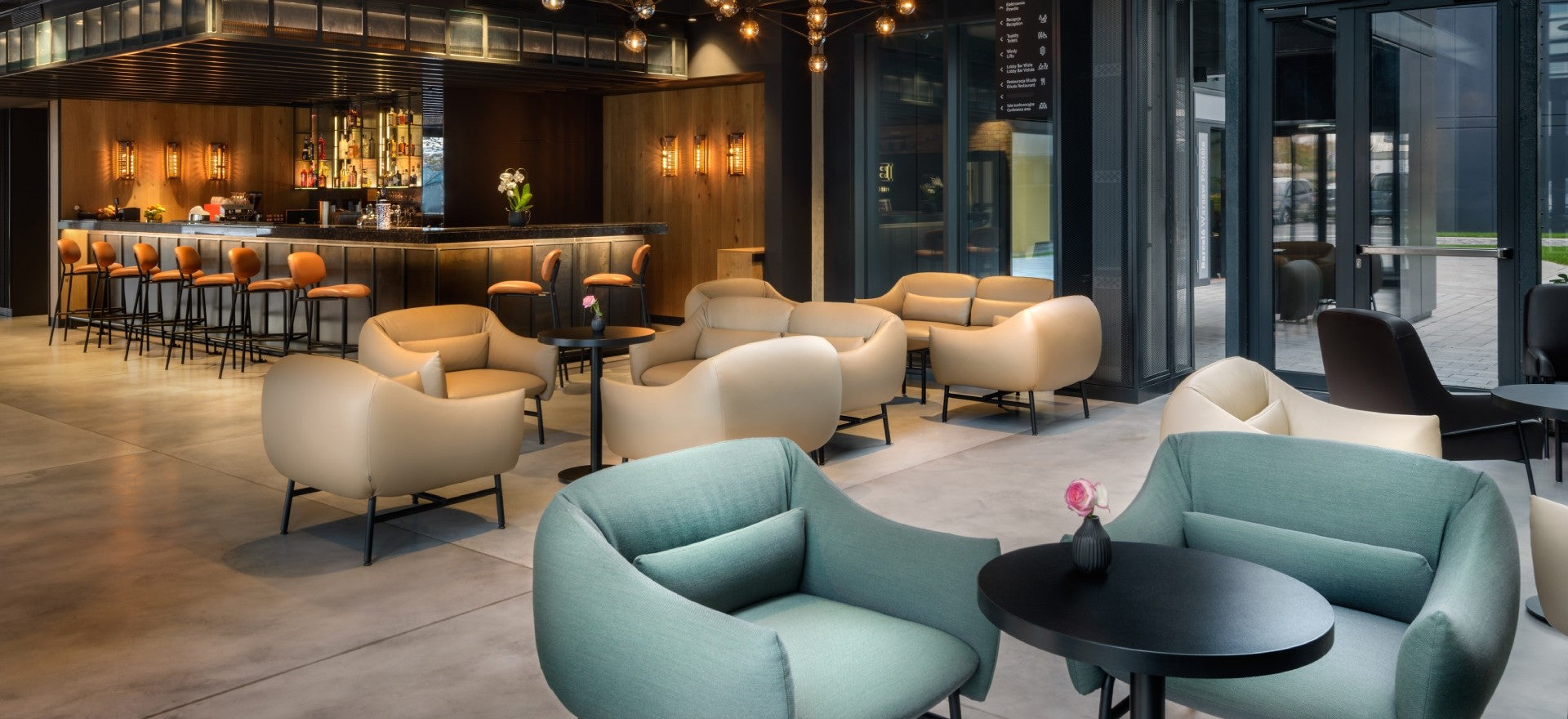
In conversation with Dawid Grausch - hospitality brand strategist working at the intersection of brand, experience and spatial strategy - we explore the precise moment when brand DNA begins to shape architecture, not as an aesthetic layer, but as structural thinking.
With over 15 years of international experience, including his role as Brand Experience Director at PURO Hotels and earlier work with Design Hotels, Dawid operates where positioning meets space and operational reality. His perspective goes beyond visual identity - into circulation, hierarchy, service flow and the business logic behind spatial decisions.
It all comes down to timing - introducing brand thinking early enough to influence how a place functions, feels and performs, long before materials and finishes enter the conversation.
![]()

Noti, Bez gwiazdek Restaurant, Warsaw PL, Design: Studio Rysik, Photo:Anna Gudaniec
1. At which stage of the design process do decisions around brand DNA truly begin to shape architecture - rather than just its aesthetic layer?
The shift happens at the concept definition stage - before any spatial layouts are fixed. If brand DNA is embedded only after schematic design, it becomes purely decorative. When introduced early, it informs the basics: hierarchy of spaces, degree of openness, circulation logic, even revenue mix.
2. In hospitality, what makes a space become a true carrier of the brand, instead of simply being a well-designed project?
Consistency of decision-making logic. A branded space is not about repeating visual cues, but about aligning every layer - layout, lighting, acoustics, service touchpoints - with a clear idea of how the place should feel and operate. Guests rarely notice design elements individually, but they immediately sense coherence (or the lack of it).
 Paged, Hotel Hygge, Opole PL, Design: Fabrykart Agata Ferenc, Photo: Mikołaj Dąbrowski
3. Where do you most often see tension arise between brand vision, operational reality and guest experience - and how can this be anticipated at the concept stage?
The biggest friction appears around service flow vs. spatial ambition - kitchens that look great but don’t work, lobbies that photograph well but don’t handle peak hours, or concepts that ignore staffing realities. This can be avoided early by mapping guest (and staff) journeys in parallel, and pressure-testing real scenarios before design is locked.
4. Can architecture influence brand perception as strongly as communication and marketing? If so, how?
Yes, and often even more strongly, because it’s non-verbal and impossible to ignore. Architecture sets expectations instantly: scale, materials, proportions, and transitions between spaces communicate positioning quicker than any campaign. It defines how a brand feels before a single word is read.

Pani Jurek, Colliers International headquarter, Warsaw, PL photo: Moodauthors
5. As a hospitality strategist who travels extensively - what spatial elements instantly build your trust in a place, and what makes you decide not to return?
Trust comes from a balance of clarity and the right kind of friction - spaces that are intuitive, but also create small, intentional moments of interaction or surprise. What breaks it is the opposite kind of friction: unclear arrival, mixed signals, or spaces designed to look good rather than actually work.
 Photo: Wiktor Franko
Dawid Grausch is a hospitality strategist working at the intersection of brand, experience and spatial strategy. He helps hotels, residential projects, and F&B concepts define clear positioning and translate it into consistent guest experiences that hold together commercially. With over 15 years in the industry, he previously served as Brand Experience Director at PURO Hotels, leading brand development, new openings, and international expansion. Earlier, he worked at Design Hotels, focusing on digital communication and brand storytelling across global markets. He is a graduate of Hotelschool The Hague.


